
Meta description: AI is helping scientists design medicines faster and smarter. Learn how AI-driven drug discovery works, where it helps, its limits, and why investors are paying attention.
Suggested slug: how-ai-is-changing-drug-discovery
Introduction
Developing a new medicine is one of the hardest, slowest and most expensive journeys in science. It often takes many years of research, testing and regulatory review, and the majority of potential drugs never reach patients.
Artificial intelligence is beginning to change parts of that journey. Biotech startups around the world, including companies working on AI-designed antibodies, are attracting significant funding because they promise to make the early stages of discovery faster, more precise and potentially less costly.
This article explains how drug discovery traditionally works, where AI fits in, what it can and cannot do, and what to watch for in the years ahead.
How Drug Discovery Traditionally Works
At a high level, creating a new medicine involves several stages:
- Understanding the disease. Researchers study what goes wrong in the body and identify a biological “target,” such as a protein involved in the illness.
- Finding candidate molecules. Scientists search for compounds or biological molecules that could interact with that target in a helpful way.
- Optimising candidates. Promising molecules are refined to improve effectiveness, safety and stability.
- Laboratory and animal testing. Early studies check how the candidate behaves and whether it appears safe.
- Clinical trials. Carefully controlled studies in people test safety and effectiveness in phases.
- Regulatory review and approval. Authorities examine the evidence before allowing the medicine to be used.
The early stages involve enormous trial and error. Researchers may need to test huge numbers of possibilities to find a few worth pursuing.
Where AI Fits In
AI is especially good at finding patterns in very large, complex datasets, which is exactly what modern biology produces. In drug discovery, it is mainly used to help with the following tasks.
1. Identifying Targets
AI can analyse genetic, protein and clinical data to suggest which biological targets may be worth studying for a particular disease.
2. Predicting Protein Structures
Proteins fold into complex 3D shapes, and that shape determines how they work. AI systems that predict protein structures have given researchers faster access to information that once took long laboratory work to obtain.
3. Designing and Screening Molecules
Instead of testing every possibility in a lab, AI can screen enormous virtual libraries and suggest molecules likely to bind to a target. Some systems can even propose entirely new molecular designs.
4. Designing Antibodies
Antibodies are proteins that can recognise and attach to specific targets, and they are used in many modern therapies. AI models can help design or improve antibody candidates, which is the area drawing interest from companies like the Welsh startup in recent headlines.
5. Predicting Safety and Side Effects
AI can estimate how a candidate might behave in the body, helping teams spot likely problems earlier, before expensive testing.
6. Improving Clinical Trials
AI tools are being explored to help identify suitable participants, monitor data and design more efficient studies.
The Potential Benefits
When used well, AI-assisted discovery may offer several advantages:
- Speed. Narrowing down candidates computationally can shorten the early research phase.
- Lower early costs. Fewer wasted laboratory experiments can reduce spending.
- Wider exploration. AI can explore chemical and biological possibilities that humans might never think to test.
- Focus on hard problems. Rare diseases and complex conditions may become more approachable.
- Better decisions. Combining many data sources can help researchers prioritise the most promising paths.
These are potential gains, not guarantees, and they apply mostly to the early stages of development.
What AI Cannot Do (Yet)
It is important to be realistic. Headlines can make AI sound like a magic shortcut, but several limits remain.
- Biology is complicated. A molecule that looks perfect on a computer may behave very differently in the human body.
- Clinical trials are still essential. AI cannot replace testing in real patients. Safety and effectiveness must be proven through rigorous studies.
- Data quality matters. AI is only as good as the data it learns from. Incomplete or biased data can lead to poor predictions.
- Regulation remains strict. Regulators require solid evidence, no matter how a drug was designed.
- Success is not guaranteed. Many AI-designed candidates will still fail, just as many traditional ones do.
The most accurate way to describe AI is as a powerful assistant to scientists, not a replacement for them.
Why Investors Are Paying Attention
Funding rounds for AI-driven biotech companies reflect a mix of scientific promise and commercial opportunity.
- Huge potential market. Successful medicines can address major health needs.
- Platform value. A strong AI system can be applied to many diseases, not just one.
- Partnerships. Smaller AI startups often collaborate with larger pharmaceutical companies that have experience in late-stage development.
- Recent progress. Advances in protein prediction and generative models have raised confidence in what is technically possible.
However, biotech is a long-term, high-risk field. Investors typically look for strong science, experienced teams, clear milestones and realistic timelines.
Questions to Ask About AI-Biotech Claims
Whether you are a reader, founder or investor, it helps to ask:
- What exactly does the AI do? Target discovery, molecule design, or something else?
- What evidence exists? Has it been validated in laboratory experiments?
- How far along is the programme? Early research, preclinical, or clinical stage?
- Who are the partners? Are there collaborations with established pharmaceutical or research organisations?
- What data does the company use? Is it high-quality and well-protected?
- Are the claims realistic? Be cautious of promises like “cure” or “guaranteed success.”
Ethical and Security Considerations
AI in healthcare raises important responsibilities:
- Patient privacy. Health and genetic data are highly sensitive and must be protected with strong security.
- Fairness. Training data should represent diverse populations so that medicines work well for everyone.
- Transparency. Companies should be honest about what their technology can and cannot do.
- Safety first. Commercial pressure must never override proper testing and oversight.
- Cybersecurity. Research data and intellectual property are valuable targets, so strong digital protection matters.
What the Future Might Hold
Looking ahead, several developments seem likely:
- Closer integration of AI with automated laboratories
- More personalised approaches based on a patient’s genetic profile
- Faster responses to new diseases
- Growing collaboration between biotech startups and large pharmaceutical firms
- Increasing attention from regulators on how AI-assisted methods should be evaluated
None of this will happen overnight, and progress will likely come step by step, with setbacks along the way.
Conclusion
AI is not turning medicine development into an instant process, but it is giving researchers powerful new tools to explore ideas, prioritise options and learn from data. Startups working on AI-designed antibodies and other therapies reflect a broader shift towards combining biology with computing.
The key is balance: be optimistic about the possibilities, realistic about the challenges and always insistent on rigorous evidence. If that balance holds, AI could help bring better treatments to patients sooner, which is the real measure of success.
Note: This article is for general information only and is not medical advice. Always consult a qualified healthcare professional about health decisions.
Category: AI & Technology (ya Health Tech)
Tags: AI in healthcare, drug discovery, biotech, antibodies, healthtech, startups
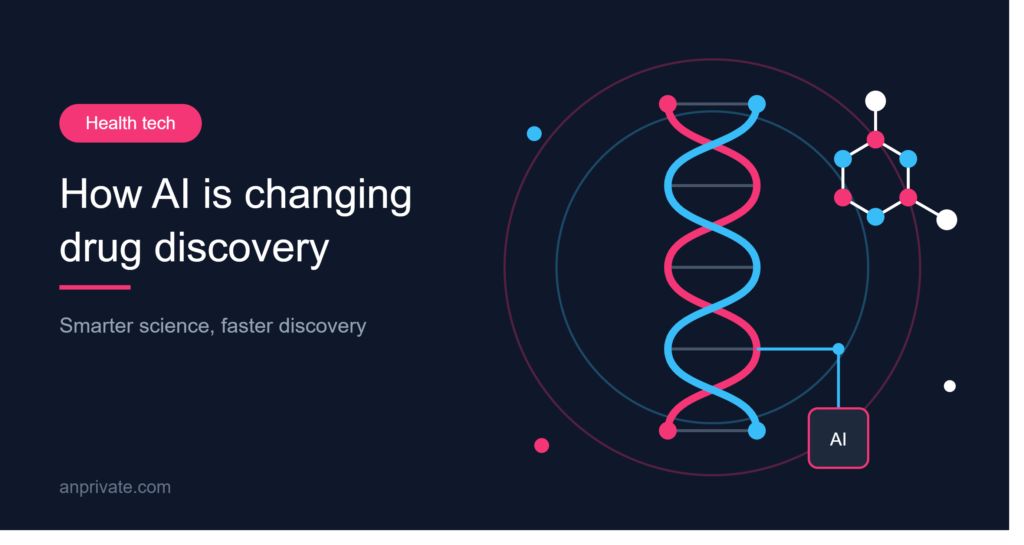
Featured image idea: A glowing DNA helix or molecule connected to a circuit-board brain, in the site’s pink and navy style.